Technology
and Activism
Copyright 2005. W.S. Herrick.
All Rights Reserved.
Photo &
Graphic Credits:
Pogo: Walt Kelly
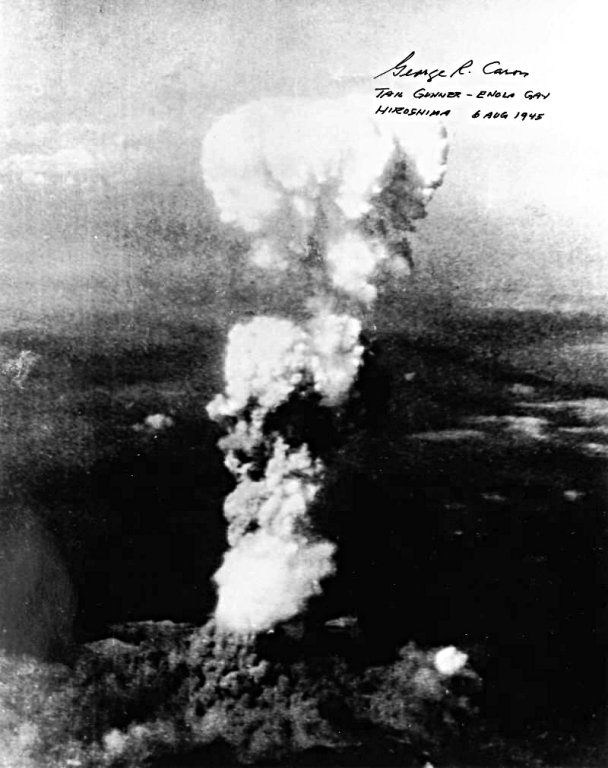
Hiroshima: National Archives
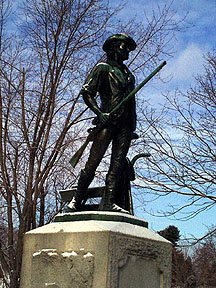
Minuteman Statue: Concord Magazine
MCST & TI SR59: anon/web
Running The Amazon: Joe Kane
Banannacom/Fred Central: Banannacom Inc
TIA logo: US DOD
Blue Bag: Sam Adams
Calvin and Hobbes: Bill Waterson
All others: WS Herrick
- Introduction and History. 2m NB: the thumbnail
images here are links to full size pictures.
 Hi. My
Name is Will Herrick, and I'm here to convey some broad strategies to
help you construct, maintain, and
profit from advanced communication technologies. I'm also going
to
indulge myself and cite some technical issues that are important to me
that may not mean
a thing to you, but I will try to be brief. My Main Message to
you is that I don't think you have a technical problem per se, but
instead an issue of institutional will. It's about how management
spends the money. It's a training and maintenance
problem.
Hi. My
Name is Will Herrick, and I'm here to convey some broad strategies to
help you construct, maintain, and
profit from advanced communication technologies. I'm also going
to
indulge myself and cite some technical issues that are important to me
that may not mean
a thing to you, but I will try to be brief. My Main Message to
you is that I don't think you have a technical problem per se, but
instead an issue of institutional will. It's about how management
spends the money. It's a training and maintenance
problem.
- My short history: Both my parents were chemists. They
met working for the Nobel Laureate, Dr. Urey, at Columbia
University.
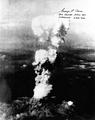
The same event that invited me into the world immolated 78,000 people
in a few seconds: sobering circumstances for thoughtful
kid.

- When I lived in Concord Massachusetts, I walked past the
Minuteman statue every morning on my way to the Louisa
May Alcott elementary school. The basic notions of patriotism and civic
responsibility got under my skin at a young age.
- I became a wilderness buff in high school, and also spent
some of my senior year in independent study with Dr.
Martin
Fuller, who had two PhDs from MIT, one in Physics and one in Chemistry,
together we pursued studies in the Social
Responsibility of the Scientist- I was fifteen.
 In
college, I took a job on the campus paper
copy reading, and being a news photographer, then production
manager. I wrote a few stories, but I had Joe Kane and others to
put me in my literal place.
In
college, I took a job on the campus paper
copy reading, and being a news photographer, then production
manager. I wrote a few stories, but I had Joe Kane and others to
put me in my literal place.
- After undergraduate work in California and New Zealand, and
with an incomplete Masters in Engineering, I returned to the woods of
Kentucky, where I still live today. I write software and support
networks for a living.
 (SKIP THIS UNLESS AV c. 20 seconds/slide
)
(SKIP THIS UNLESS AV c. 20 seconds/slide
)
- Next I'd like to critique some my own efforts over the
years. The results have been very mixed.
4m.
- 1969: The
MCST & flunking English. 1974: Newspaper Layout stats.
BEC.
c. 1984: SWEC & Training NGOs.
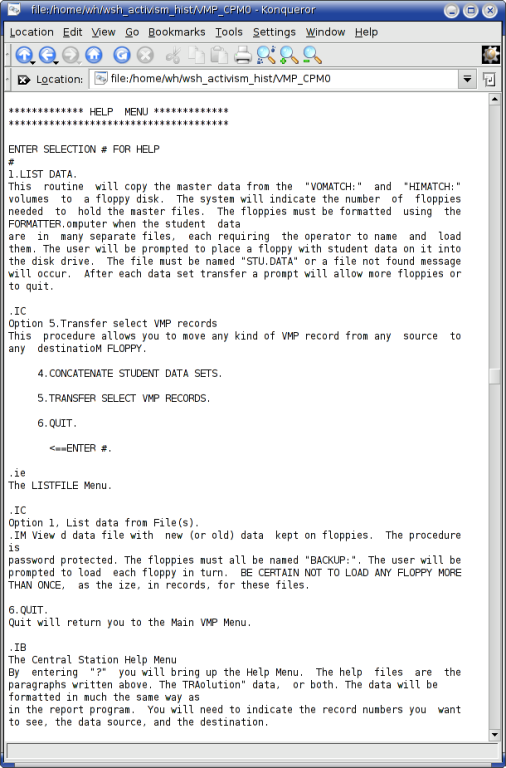
 1984: SpEd: VMP &
LAKES. 1988: Landfills and Incinerators.
1984: SpEd: VMP &
LAKES. 1988: Landfills and Incinerators.
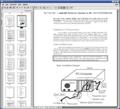
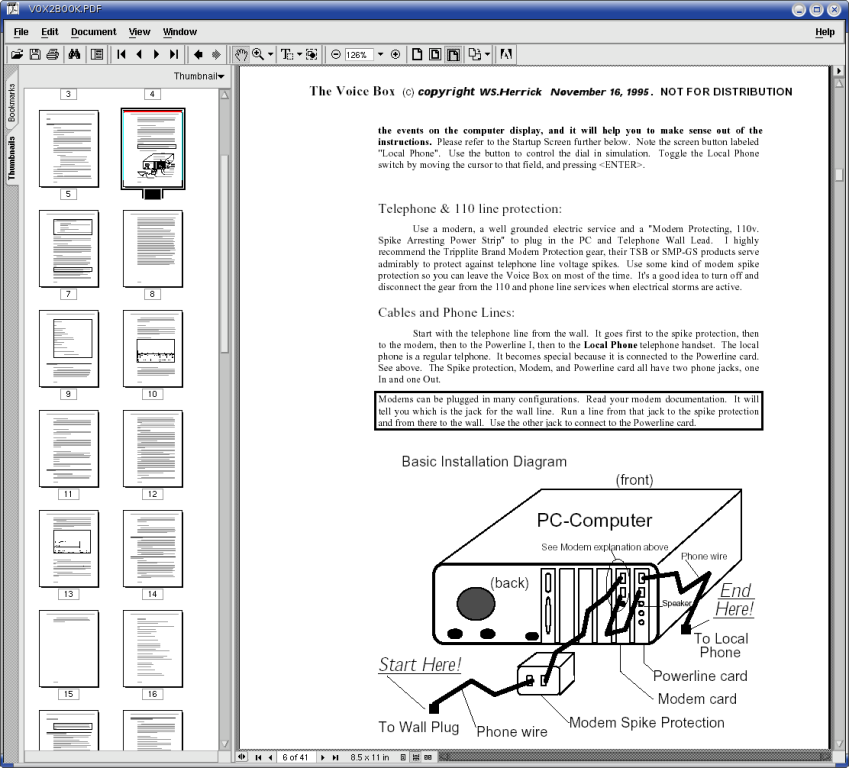
 1990: The
Voice Box. WAIT
&
MedWaste. Logging and mining regulation.
1990: The
Voice Box. WAIT
&
MedWaste. Logging and mining regulation.
-
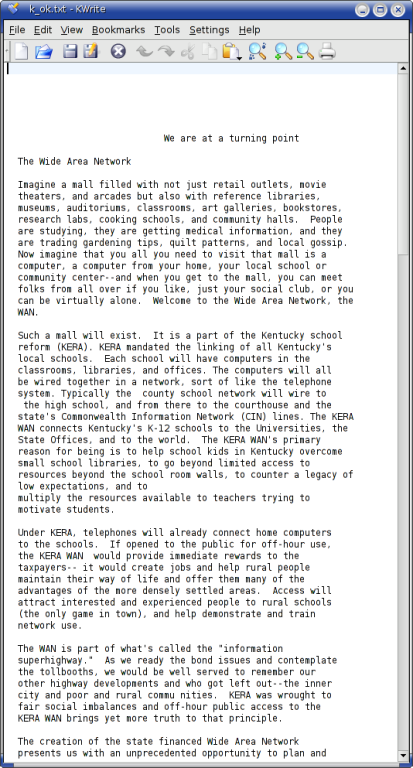
 1992: The Commonwealth
Fellowship, KERA & brain drain.
1992: The Commonwealth
Fellowship, KERA & brain drain. 
 1995: Seven BBS'
&
Satellites. The radio show. Internet and the last
mile. Garbage billing.
1995: Seven BBS'
&
Satellites. The radio show. Internet and the last
mile. Garbage billing.
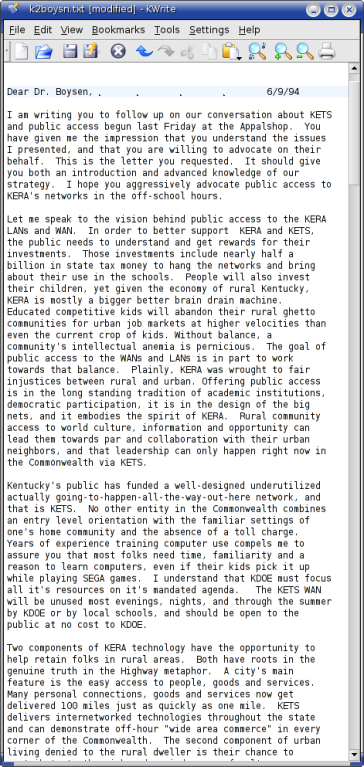
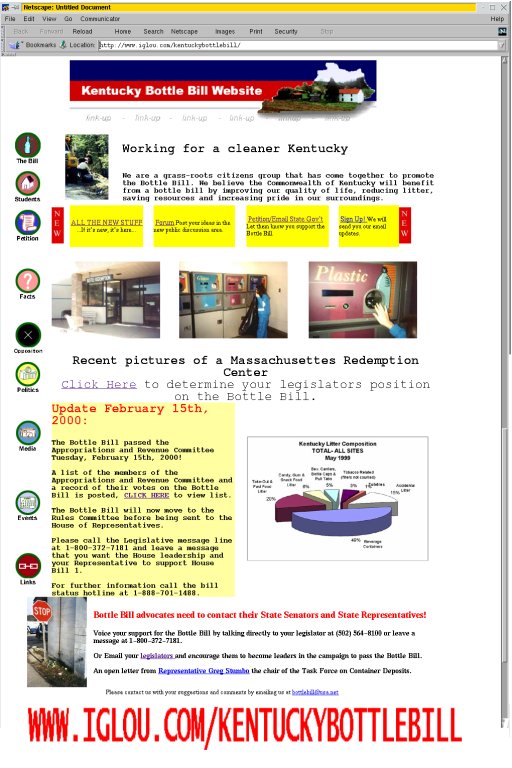
 1998-2000: Kentucky
Bottle Bill & other
Web
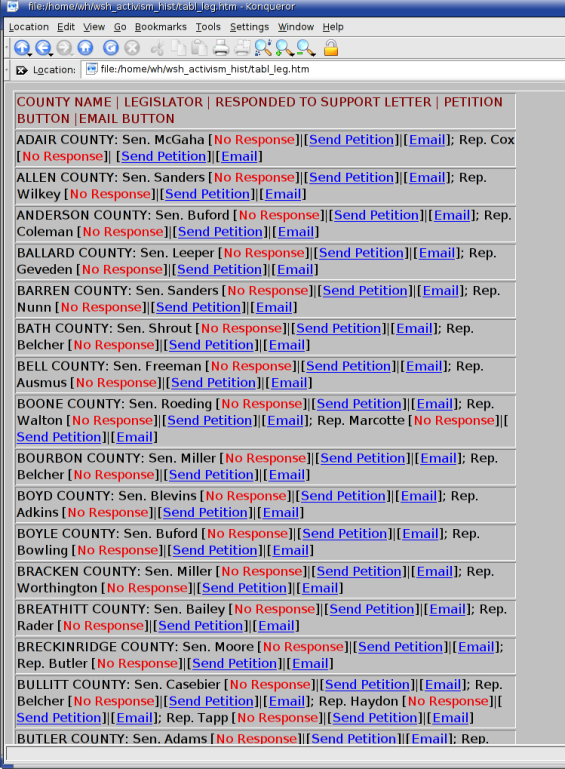
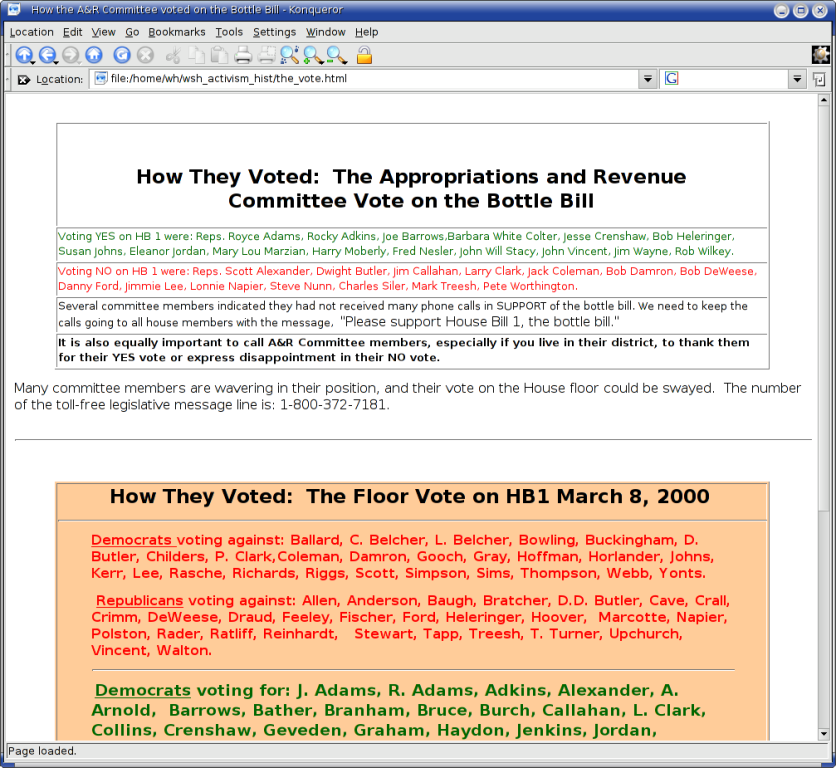
sites. CMS'. The HB1 poster campaign.
1998-2000: Kentucky
Bottle Bill & other
Web
sites. CMS'. The HB1 poster campaign. 
 2002: Trash
& IGCC:
Trapp. KRC & the
online libraries. Broadband &
leadership.
2002: Trash
& IGCC:
Trapp. KRC & the
online libraries. Broadband &
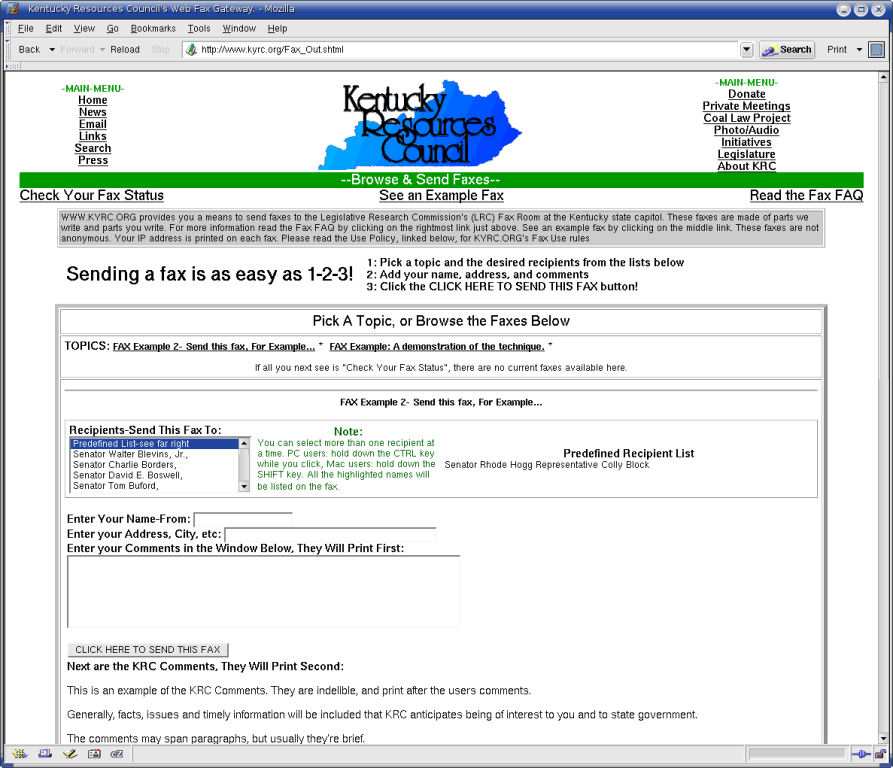
leadership.  2003; FlipperFax.
2004: ReadTrim.
2003; FlipperFax.
2004: ReadTrim.  2005: Secure wireless. #tecactv,
for a lark.
2005: Secure wireless. #tecactv,
for a lark.
- (2 m) Some of the sites I've set up have failed due to poor
support
from the content providers. None have been hacked or crashed-they
just got Stale. Most web sites are not set up by
folks ready to start a newspaper or magazine, although that is the
level of
attention and support an
 attractive
dynamic site
requires. Most groups have just wanted a site that presents their stuff
to a
larger audience and brings new folks to their organization.
Institutions that have a longer commitment may find
it
hard to retain the staff to sustain the site. That leads them to
outsource it, but that still fails to address the constant need for
fresh
information. Keeping a site fresh and
tasty-like the newspapers, is a Real Job that requires
talent, commitment, experience, money, content and a group effort.
attractive
dynamic site
requires. Most groups have just wanted a site that presents their stuff
to a
larger audience and brings new folks to their organization.
Institutions that have a longer commitment may find
it
hard to retain the staff to sustain the site. That leads them to
outsource it, but that still fails to address the constant need for
fresh
information. Keeping a site fresh and
tasty-like the newspapers, is a Real Job that requires
talent, commitment, experience, money, content and a group effort.
- I tend to design to a lower common denominator than
many, opting for reliability, speed and a uniform look & feel over
the "rich media
experience." The need to build a productive and functional site
generally leads me away from the bleeding edge, back to stable
platforms and proven tools. Instead, I try to use computing power
and software functions to add value.
- Many of my clients have been early adopters, which
like television in the US, has cast them in an older technology that
they'll
need to spend money to update. To reach the audiences that need
less text and more graphics, both you, the provider, and your
audience need more
bandwidth You'll also need content talent (writers), and caliber
tools to construct
and maintain the
graphics. None of the NGO's I've dealt with could muster the
resources to provide the maintenance, content, and design needed
to run a high end site for very long, if at all. The lesson for
me is that content support and site
training both need a lot of attention and a consistent design
guideline as well as funding. This is where my interest in
Content Management
Systems comes from.

- Soapbox 101. Activism in Technology:
Opportunities and Suggestions. 10m

- Before I proceed to talk about a number of practical ways that
activism can
be assisted by available technology and training, I'd like
to talk
about the Big
Technology Picture, where I think things are looking Very Bad.
- A part of the problem: three year olds are learning the
Internet
before they are learning to read. How do we present our message
to get the
three year olds, the high schoolers or the college grads. None of
these groups have been seriously targeted for modern telecommunication
by the
progressives I've dealt with. If we want to include them, we have
to invest the time, understanding, and money to do it. It takes
building a site two or three
different ways, with and without graphics, for example.
That's a lot more effort.
- It takes time to grow the user base, so
the payoff is deferred. As well, there is no entirely accurate
way to measure site usage-so many of the "hits" are not
human eyes on the page at all, but instead, software agents
searching
for content, or they are fabricated or spoofed counts making money for
advertisers, or redirected routes
that aren't really humans trying to come your site. One cannot
easily measure the real usage or impact.
 Archiving
and
preserving digital data for the long run:
We must bear the burden of not losing our history and evidence.
Archiving
and
preserving digital data for the long run:
We must bear the burden of not losing our history and evidence.
- Digital data formats are advancing rapidly, and as a rule,
the storage
media for those data fail quickly or the devices needed to read the
data are
lost. Consider the age of some of the records in the recent
tobacco or asbestos litigations. If we are going to preserve
evidence for the future, something needs to change.
- Imagine when
global warming has flooded the US coasts, and new law allows us to
prosecute those who knowingly profited, like we have the tobacco
companies. It's our job today to develop the proof of who knows
what, and to preserve that evidence for the coming decades.
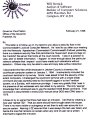
- Federal legislation was introduced this week to require the
retention of all Internet Server log files for up to two years.
Contrast
this with
the Kentucky Government's policy to destroy government emails within
two weeks. The author David Brin has followed through on IF
Stone's perception of truth and secrecy. Brin's recent book "The
Transparent Society", provides the argument that civil trust can only
by preserved allowing the public to watch their own government in the
same manner that the government watches them.
 There
is now a desperate fear of email, backups, file caches and server log
records in some circles of government. It's an interesting
conflict, that governments around the world are inserting cameras and
microphones on every street corner, while taking great pains to assure
that
they themselves are never recorded unaware. Our current president
disavows email, and now our
governor's administration has begun to abandon them too. This is
a crippling move on their part, and they will not be able to function
well absent the common technologies the rest of us use to good
advantage.
There
is now a desperate fear of email, backups, file caches and server log
records in some circles of government. It's an interesting
conflict, that governments around the world are inserting cameras and
microphones on every street corner, while taking great pains to assure
that
they themselves are never recorded unaware. Our current president
disavows email, and now our
governor's administration has begun to abandon them too. This is
a crippling move on their part, and they will not be able to function
well absent the common technologies the rest of us use to good
advantage.- I expect that there will be a quiet effort to change
state policy and destroy all digital copies of internal government
documents as a rule, rather than retain them as a rule. We
should not permit that, for there lies
truth-on-demand, fabrications, conflations, and deceptions.
While Jesse Ventura argues that the public doesn't want to know the
truth, some of us do. Someone has to make decisions based
on facts, not fabrications.
- Much of the "new" activism in technology has been to
sow doubt or obfuscate. Legitimate market driven research
and development has bled over to "Product
Protection" (see current SciAm 6/05). Those of you following the
news know that many top advisers in our state and federal
leadership are vetted by, likely come from, and will return to
the industry they are governing-their infidelity to the office and
public responsibility is becoming well documented. Hopefully
public outrage at this treacherous betrayal of the public trust will
lead to change.
- Among some university researchers, one in six women, and
one in ten
men report pressure to alter results (per Assoc Univ
Teachers: The
Guardian, Donald MacLeod, Tuesday March 22, 2005). Similar
reports can be found in Life Sciences (2/10/05: SF Chronicle), and
Wildlife research (LA Times 2/11/05). This is Really Bad:
the integrity of researchers is now in doubt, a
circumstance that works for those promoting dangerous and dubious
products, and against those trying to accurately and affordably assure
public safety
and health.
- Conversely, I'd note that there is an equally active
campaign to sow political "belief." The whisper campaigns are an
example, as are the political organizing
campaigns going on from the pulpit, and the procrustean 'ethnic
cleansing' of churches in East Kentucky and elsewhere that coerces
agreement by ostracism and disorganization of the dissenters.
I've
heard of many local complaints about the politicization of the
churches, and I'm sure that there are thoughtful honest
churchgoers that have grave concern for the divisiveness and the
exclusions.
- I find the ying/yang of the disbelief/belief
initiatives thought provoking.
 The
Identity Theft problem is bleeding over to the Total
Information Awareness problem. Many of you have become aware of
the threats to your financial and retirement security from identity
theft, and are taking steps to address it. However, the
appropriate
strategies for protecting you are contrary to the war on terrorism and
John Poindexter's notion of privacy. While Mr. Poindexter's TIA
was clipped, along with the Office of Strategic Influence (now a rock
group!),
Poindexter indicated that the US would simply buy the solution from the
private sector, to the same effect. Now, apparently, the US hires
multi-national
firms to provide them with TIA-like services. Many
of these firms are also reporting wholesale theft of their data, but
mostly
just in those states where they are required to report it. To
close my mention of Mr. Poindexter and technical activism, one of the
largest blogs on the web is SlashDot: News for Nerds.
The Slashdotters took up Mr. Poindexter's gauntlet and within a few
hours they produced a website with maps, aerial photos, satellite
photos, driving directions, phone numbers, mailing addresses, family
members, proximate watering holes appropriate for surveillance, and so
on. Apparently Mr Poindexter's wife does not share his
perceptions of privacy, as she was reportedly upset.
The
Identity Theft problem is bleeding over to the Total
Information Awareness problem. Many of you have become aware of
the threats to your financial and retirement security from identity
theft, and are taking steps to address it. However, the
appropriate
strategies for protecting you are contrary to the war on terrorism and
John Poindexter's notion of privacy. While Mr. Poindexter's TIA
was clipped, along with the Office of Strategic Influence (now a rock
group!),
Poindexter indicated that the US would simply buy the solution from the
private sector, to the same effect. Now, apparently, the US hires
multi-national
firms to provide them with TIA-like services. Many
of these firms are also reporting wholesale theft of their data, but
mostly
just in those states where they are required to report it. To
close my mention of Mr. Poindexter and technical activism, one of the
largest blogs on the web is SlashDot: News for Nerds.
The Slashdotters took up Mr. Poindexter's gauntlet and within a few
hours they produced a website with maps, aerial photos, satellite
photos, driving directions, phone numbers, mailing addresses, family
members, proximate watering holes appropriate for surveillance, and so
on. Apparently Mr Poindexter's wife does not share his
perceptions of privacy, as she was reportedly upset.
- Recently, a court in the northern US declared that the mere
presence of
encryption technology was grounds for suspicion...yet all of you use it
daily-it's how you secure the Internet and authenticate your online
banking, purchases, and email. The day of that press release, I
had
just installed encrypted directories on all my machines to secure my
personal and tax information. You should do that too:
hard drives get sold, machines get hacked, and computers get
stolen. If you'd encrypted your data, you can be sure it is a lot
of trouble and nearly impossible to decode.
- Another example is this week's news is
that Microsoft, in the name of shareholder and management profit,
censored the words "democracy" and "freedom" from crossing their
Internet
servers in China. As the Internet ages, and the memory of
egalitarian
democracy fades in this country-would a profit motivated Microsoft ban
"freedom" here too? In another example of technical activism that
contrasts
strongly with market driven censorship, the Electronic Frontier
Foundation and others are writing anonymizers that make locating the
author nearly impossible. While out of favor in a world driven by
Terror
from Non-State Agents, you will find that one day you'll desire and use
these for yourself as the best means to assure your personal
information safety from TIA and identity
theft. They will become a common utility like the
once-controversial encryption
technologies.
- The Intellectual Property (IP) Commons & the erosion of
public intellectual
property has been especially troubling to me: most folks have no
notion of how media companies and
large software companies have found common cause in the restriction of
public intellectual property rights. In the face of losing the
copyrights on Mickey, Minnie
and Goofy, Disney lobbied for and got significant extensions to their
exclusive rights to the characters, rather than the scheduled transfer
to the public domain.
- Likewise,
 Microsoft and other software
houses began to receive software patents for things like mouse clicks
and window structures. Very poor work has been accepted by the
US Patent Office regarding prior art and the legitimacy of some
proposed
patents. Both the entertainment and software industries have a
long
history of standing on the "shoulders of giants." But now they
are trying
to close the gates, and lock in their particular industry
dominance. A basic
example being the fundamental mouse and window GUI- a Xerox invention
taken up by Apple, then Digital Research Inc, Amiga, and
Microsoft. Microsoft has
patented everything they could-not just sophisticated technical
innovations that they have made, but previously unclaimed common
practices-and thanks to the US Patent Office and the public's
inattention, these patents
are commonly issued. This ossification
defeats innovation and market competition.
Microsoft and other software
houses began to receive software patents for things like mouse clicks
and window structures. Very poor work has been accepted by the
US Patent Office regarding prior art and the legitimacy of some
proposed
patents. Both the entertainment and software industries have a
long
history of standing on the "shoulders of giants." But now they
are trying
to close the gates, and lock in their particular industry
dominance. A basic
example being the fundamental mouse and window GUI- a Xerox invention
taken up by Apple, then Digital Research Inc, Amiga, and
Microsoft. Microsoft has
patented everything they could-not just sophisticated technical
innovations that they have made, but previously unclaimed common
practices-and thanks to the US Patent Office and the public's
inattention, these patents
are commonly issued. This ossification
defeats innovation and market competition.
- Look around the room and most of the folks you see are
Windows users. I've challenged many of you in the past to keep
learning and trying new software. I'd like to
close this part by saying that, I believe you could have spent your
money over the past decades more wisely by
fostering competition and buying into the best innovations of the day,
rather than the monolithic monopolistic result you have
purchased.
Diversity alone would have made the current Microsoft virus
problem a smaller
threat.
- In short, there are a lot of buggy whip vendors doing a great
job of
advertising or legislating dislocations of market truth to
acquire market instead of innovating and competing.
 The
buying of journalists in this country has done
great damage to the fourth estate, and like the bent research described
above, has cost the honest journalists of the nation much
of their deserved authority-again to the advantage of the dissemblers,
murkers, and corrupters. Too many honest and important technologies are
being
spun, and I regret wondering how many duplicitous journalists are
taking pay to propagandize under the guise of accurate and honest
reporting.
The
buying of journalists in this country has done
great damage to the fourth estate, and like the bent research described
above, has cost the honest journalists of the nation much
of their deserved authority-again to the advantage of the dissemblers,
murkers, and corrupters. Too many honest and important technologies are
being
spun, and I regret wondering how many duplicitous journalists are
taking pay to propagandize under the guise of accurate and honest
reporting.
- Among our federal reactions to 9/11 has been the decision to
cut off the flow of
international grad students to the US. China has taken up much of
the slack. The federal government's policies are squelching
America's role in the important research going on in the world
today. The research prohibited in the US is
still being done, and will be done regardless of US moral
suasions. All we've accomplished is
to assure that it will done somewhere else.
America is poised to become a client nation, purchasing from others
what we should be inventing and producing here.

- I
have a friend who now lives in a subdivision she protested against as a
college student: I am confident that many who support cutting
medical research to satisfy their moral superiority will be among
the clients traveling abroad to buy the very medical relief condemned
here.
-
- Practical Suggestions. 10m
 My Main Message: it's not the tech, it's
the institutional will,
and
the money that management spends. It's a training and maintenance
problem.
My Main Message: it's not the tech, it's
the institutional will,
and
the money that management spends. It's a training and maintenance
problem.
- I've been told by David Couch, the state's Director of
Educational Technology, that the biggest impediment to
adopting new
technology for the KERA WAN and public schools is the lack of trained
support staff. It's the same all over-the biggest impediments to
new tech are support and training.
 In terms of web sites, Content Management
Systems address that problem to a degree. The
purpose of a Content Management System is to simplify the construction
and automate the maintenance of web sites.
In terms of web sites, Content Management
Systems address that problem to a degree. The
purpose of a Content Management System is to simplify the construction
and automate the maintenance of web sites.
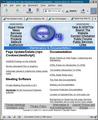 They are programs that
typically
reside on the web server computer & offer a secure WYSIWYG GUI that
generates your website from text and pictures that you cut and
paste. They are the "shortest distance" from your desktop to the
web & relieve the author from a lot of technical
issues.
They are programs that
typically
reside on the web server computer & offer a secure WYSIWYG GUI that
generates your website from text and pictures that you cut and
paste. They are the "shortest distance" from your desktop to the
web & relieve the author from a lot of technical
issues.
-
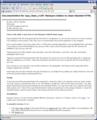 CMS' are
really nifty in that
they can manage the "look and feel" of
your website-keeping a common font and style regardless of what you
paste, for example (that is optional, I might add). CMS' allow a
secure
means to sublet columns and pages on a website, so more than one person
can contribute.
CMS' are
really nifty in that
they can manage the "look and feel" of
your website-keeping a common font and style regardless of what you
paste, for example (that is optional, I might add). CMS' allow a
secure
means to sublet columns and pages on a website, so more than one person
can contribute.
 The last Really Big Virtue
of the CMS is that
once you've mastered the tool, you can make many different websites,
each unique in their style, layout, and content, but all with a common
software and skill base. That means that folks trained on one
site have every technique they need to maintain another.
More available talent for an employer and more work for a trained
individual adds
up to a good market, so as a group you can make group purchaeses to
develop and retain talent.
The last Really Big Virtue
of the CMS is that
once you've mastered the tool, you can make many different websites,
each unique in their style, layout, and content, but all with a common
software and skill base. That means that folks trained on one
site have every technique they need to maintain another.
More available talent for an employer and more work for a trained
individual adds
up to a good market, so as a group you can make group purchaeses to
develop and retain talent.
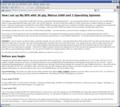
- You should consider the hi quality open source tools: the
Apache webserver, Mozilla, Oo, perl. This entire
presentation, and all of my websites has been done with just
these tools. The fax server, FlipperFax, is written in perl.
 Linux
is the next
Metric System. It's in major usage in the new IT powerhouses of
India, Brazil,
and the broadband rich far east. It is in escalating use on all
scales of computing from the $12 MagicFrame, to PDA's, to PC, clusters
& distributed
processes. I doubt many here will rush to dump their current
desktops, but it is a serious and valid option for your consideration,
especially if you are looking at a lot of desktops and licenses.
Linux
is the next
Metric System. It's in major usage in the new IT powerhouses of
India, Brazil,
and the broadband rich far east. It is in escalating use on all
scales of computing from the $12 MagicFrame, to PDA's, to PC, clusters
& distributed
processes. I doubt many here will rush to dump their current
desktops, but it is a serious and valid option for your consideration,
especially if you are looking at a lot of desktops and licenses.
- I'd also commend the Open Source strategies: of peer
review,
transparency, net-moderated collaboration and IRC that all work
well. The
exploitable error rate in open source software has been measured to be
10e-3 that of closed source. If you would like an excellant
example of this method in action, visit irc://freenode/madwifi
where you can see volunteers sharing knowledge to train and support
wireless technologies.
- The
over 30 set needs to take a page from our old yippy manual, and start
trusting the youth of the world, and learn what they've learned.
The Instant Messaging/wifi/VOIP/Blackberry phenom won't go away
just because some politician gets in a jam-Did audio recordings go away
just because of Nixon's experience.
- To keep you site visiible on the search engines, establish a
machine observable trust system, to wit: a
bunch of websites that all cross link. It elevates all the sites
scoring in the search engines. If you develop them in an
honest fashion, they will rank well in the search engines. Don't
look like phishers or spammers if you don't want to get blacklisted.
 So it's my suggestion to you that you train your staff on how to
build and manage your websites with
a collaborative model & common CMS.
So it's my suggestion to you that you train your staff on how to
build and manage your websites with
a collaborative model & common CMS.
- Costs to build and operate websites will vary from NGO to NGO
and issue to issue. These costs will mostly
depend on the NGO's own willingness to learn the tools, and on
their
goals.
 NGO's
have some common features and problems: these are your challenges
to overcome if you are to collaborate and share a talent pool of
trainers, authors, and support.
NGO's
have some common features and problems: these are your challenges
to overcome if you are to collaborate and share a talent pool of
trainers, authors, and support.
- NGOs have a mission, a
reputation, and a culture.
- They cannot afford loose cannons, or loose
lips, they cannot stray far from their mission, they get grief when
they
step onto the turf of other NGOs, and they fear offending their
donors.
- They may have to compete for dollars with their
fellow travelers.
- They cannot
reliably fund initiatives beyond their core scope.
- They generally don't
have the money for production grade software development, or the skills
to manage R&D.
-

Technicals you employ may bring problems too: many have little
political initiative, are too much in love with their toys, or have
lousy people skills.
- How
to make office
and institution technology cheaper.
- Recognize and reward in-house talent & service. It
might not take
dollars.
- Don't drop the ball: make your backups.
- Survey the field on a regular basis and try to spot tools
and methods that look promising.
- Pick your tools carefully.
- Be very clear about the problem. Be very clear about
the solution.
- Skunkworks vs the usual process.
- Do not change design (much) after you've committed, it's
create bugs and cost money.
- Hire the right number of people at the start- adding manpower
to R&D after the start usually slows it down, as all the beginners
have to climb
the learning curve before they can contribute to the
effort. This is _Very_Important_.
- Pay techs enough to avoid churning & disruption. If
you lose all that training and experience, you'll just have to start
over, and change all the passwords.
- Consider Open Source stuff- 10e-3 error rate, security
designed by phone companies and vetted by 30 years of field
installation, free like speech and free like beer.
 How
to attract
hearts and minds. The active construction of doubt and uncertainty by
commercial agents pretty much assures that any message we try to
present will have to endure a very noisy medium, with active jamming
and spoofing from the Deaver's and Finkelsteins of the world as our
message percolates through the media.
How
to attract
hearts and minds. The active construction of doubt and uncertainty by
commercial agents pretty much assures that any message we try to
present will have to endure a very noisy medium, with active jamming
and spoofing from the Deaver's and Finkelsteins of the world as our
message percolates through the media.

- Heroes: Joe
Begley:
"Everybody ought to go to jail once for something that they believe in".
- Market share, mind share and heart share: they all take
time. While starting early maximizes the return, kids
generally aren't
gatekeepers, they don't sue, write big checks, drive to the state
capitol, or vote: we need a
whole lot more than just the youth. How do we better
organize our effort to shape the perception of the future?
- New avenues and media: text messages, rss feeds,
pods & net narrowcasts.
- Suggested training:
- Netiquette, fire hoses, and synthesis.
- Training the
email/IM culture. Don't flood email.
- Maintain your sites and your
lists.
- Authentication/certificates/encryption.
- Suggested Hardware:
- Get a good laptop
- Get a good presentation technology.
- If I thought there was money to do it, I'd build a google
news-like "synthesis" site harvesting and
presenting current postings germane to Kentucky and progressive
action. It might bring cross-fertilization
and
attract new blood. It could automate harvest of the postings
on the individual NGO's site
followed by a little straining, sorting, and filtering. This
leaves the
burden on the NGO to maintain their own site. It should usually
return the viewer to the NGO's site for
the article of interest. It dodges a lot of the turf and
competition issues. I might build one, but it's a Big Job.
- Imagine a magazine that reviewed Kentucky environmental
activities...now try to guess for me how many arenas, like Environment,
there are in this crowd of 'progressives', IE: how many magazines
would it take to cover the whole bunch... this is a rough measure of
the number of 'synthesis' sites that you might benefit from.
 Issues
Gathering and Quick Synthesis. 15m
Issues
Gathering and Quick Synthesis. 15m
- Intro to IG method.
- What goals do the attendants have?
- Do you have target audiences?
- What's stopping you from achieving them?
- Would it be a good idea to self-organize?
- Can you find the means and will to begin training & design?
- Synthesis
- Conclusion 5m
- The cradle to grave era of full time personal networking is
upon
us. We have a challenge to recast our means of community from the
geographic locale to a common site in cyberspace, and to take
advantage of the new mechanisms available to the always
connected. What new communities can we build or join?
 We
have a challenge
and an obligation to better manage our digital legacy. Pay
attention to the age of your media and hardware. Pay the cost of
replicating your data. Do it in a way that preserves it's
authenticity and value as legal evidence.
We
have a challenge
and an obligation to better manage our digital legacy. Pay
attention to the age of your media and hardware. Pay the cost of
replicating your data. Do it in a way that preserves it's
authenticity and value as legal evidence.- The basic training has been the one
sure shot.
- Good web sites are hard to do, and take a lot of
effort to maintain and support.
- Put money into training. You can start that now. If
you form a planning group, re-align
your training as your planning group comes into productive play.
- Put money into scope and design. Use it to buy a
plan
to build a group that can scope, plan, implement and support your needs.
- Make a team that reflects your goals and audiences. Make
it a permanent thing, pay them, retain them, and pay attention to them.
- I'd suggest that you survey CMS's & training/support
options. Keep the magic behind the curtain as best you can.
CMS' work a lot of magic, and can be managed both
centrally and by 'sub-letting' or parceling out the maintenance.
- There are institutions that will facilitate the
training.
Much of the training can be done online, as well.
- Try to harmonize the CMS' and the training among your
groups. If you can
define the common factors in your network services, you can buy
training and talent as a group. In-house support is the best,
when it works. It usually fails because it's a hard job
that comes with few rewards, but management can address that:
acknowledge the job and pay for it.
- Plan to spend long term money on talent and maintenance.
if you are
serious, you'll find structural monies and plan for ongoing
initiatives.
- Try to make it all fun.

- Q&A. 10m

wh
June
17, 2005
- Examples of
technology and activism that you may already
know:
- The Manhattan Project
- NASA.
- Phil's Pretty
Good Privacy: PGP, cypherpunks and the early crypto wars.
- The APACHE web server-software that nobody owns exactly, but
runs half the Internet.
- GNU/Linux's unique success of gaining market share from MS.
 Hactivism:
EFF, HOPE, etc.
Hactivism:
EFF, HOPE, etc.- Lee Todd/UK & the LITF. University of Kentucky
president, Dr. Lee Todd, has been organizing technology
fairs, and promoting R&D in solar, recycling, and a whole lot
more. I find it very heartening to see headlines like "'Plastic oil' could improve fuel economy in cars,
chemists say" stemming from research done at UK
(http://www.physorg.com/news4509.html). Maybe we can encourage
our federal deep pocket types to capitalize on the recent Hybrid car
production in Georgetown, R&D like recycled plastics, and Todd's
own field of expertise (luminance) to launch more green tech R&D in
Kentucky, like solar